Bridging vs Commercial Mortgages: The Only Sensible Way to Choose
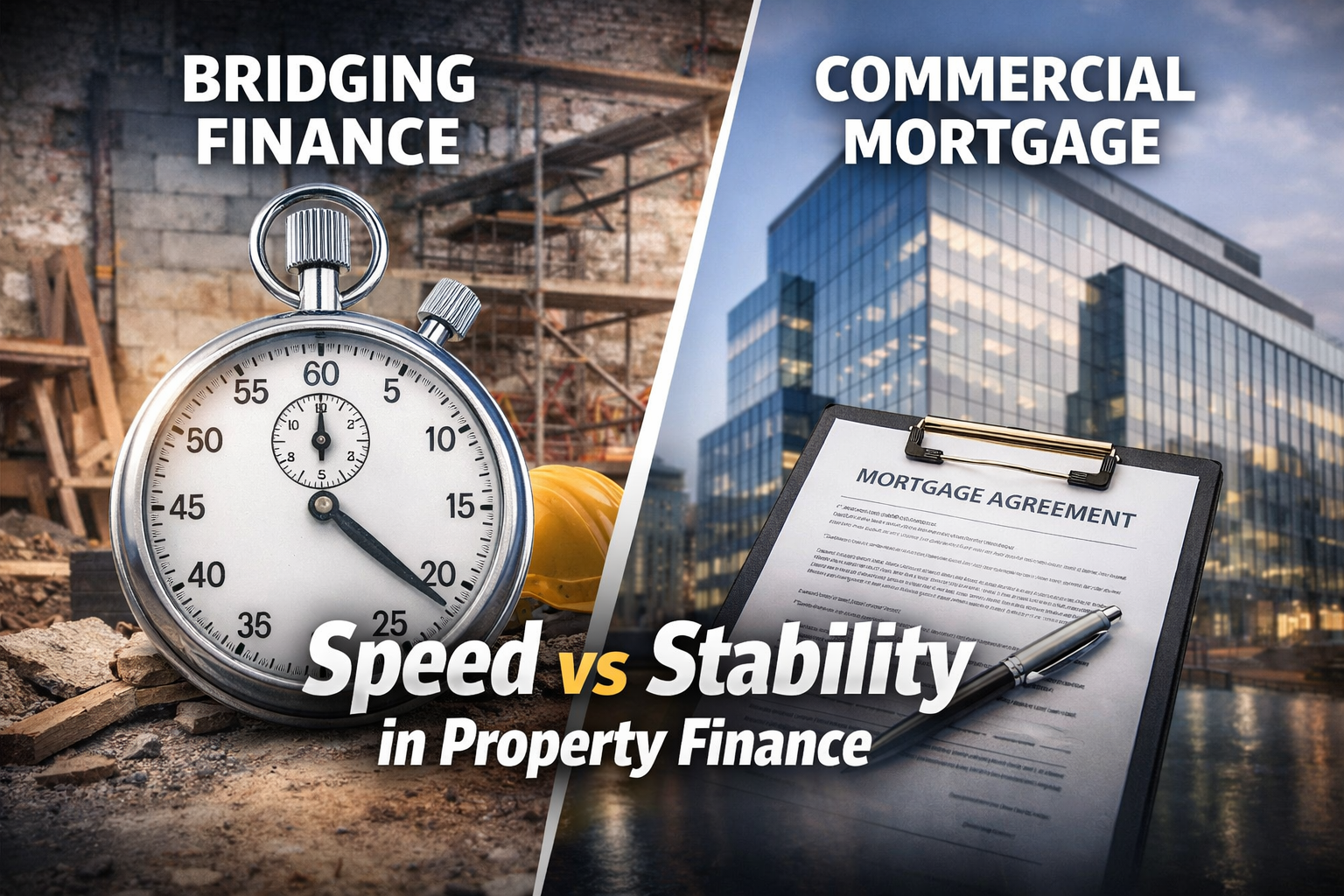
Bridging vs Commercial Mortgages: The Only Sensible Way to Choose
(From a Sheffield Property Investor Who Won’t Sugar-Coat It)
Lead
If you invest in UK property today, you’re constantly balancing speed and stability.
Deals still move at auction pace.
Valuers are cautious.
Underwriters are picky.
And legal processes almost always take longer than the brochure suggests.
Right in the middle of that chaos sit two funding tools that carry most property deals:
Bridging finance
Commercial mortgages
Choose the wrong one and you either lose the deal or bleed profit.
Choose the right one and you can execute a clean BRRR strategy, stabilise cashflow, and move on to the next opportunity.
I’m based in Sheffield and have seen both the textbook deals and the expensive lessons.
This article is the no-spin version.
The Real Problem Most Investors Don’t See
Too many investors compare loans using headline interest rates.
That’s the wrong comparison.
The real trade-off is:
Speed vs certainty
Flexibility vs covenants
Short-term value creation vs long-term stability
Once you understand that, the choice becomes much clearer.
Bridging Finance: Fast Money for Value-Add Deals
Bridging loans exist for one reason:
Speed.
They allow investors to secure properties that traditional lenders simply won’t touch.
Typical scenarios include:
Auction purchases
Heavy refurbishments
Vacant commercial units
Properties with poor EPC ratings
Title issues or short leases
Complex ownership structures
A bridging lender focuses less on long-term affordability and more on the strength of your exit strategy.
Typical bridging characteristics
Monthly interest: ~0.65% – 0.95%
Loan term: 6–12 months
LTV: up to ~70–75%
Completion: 2–4 weeks (sometimes faster)
Yes, bridging looks expensive.
But that’s only true if you use it incorrectly.
If you buy a distressed asset, improve it quickly, and refinance within months, the overall return can still be excellent.
Where bridging becomes dangerous is when investors treat it like a long-term loan.
That’s how deals turn into disasters.
Commercial Mortgages: Stability and Long-Term Cashflow
Commercial mortgages are a completely different animal.
They are designed for stable, income-producing assets.
Instead of focusing on speed, lenders focus on income security.
They analyse things like:
Tenant covenant strength
Lease terms
Rental coverage ratios
Property condition
Long-term sustainability of income
Typical commercial mortgage characteristics
Interest rates: ~5–8% annually (varies widely)
LTV: 60–70%
Loan term: 5–25 years
Completion: 8–16 weeks
The key metric lenders care about is usually:
DSCR / ICR (Debt Service Coverage Ratio)
Which basically answers one question:
Can the rental income comfortably cover the loan payments?
If the numbers work and the tenant is strong, lenders are happy.
If not, the deal stops there.
The Biggest Mistakes Property Investors Make
After seeing plenty of deals go right — and wrong — a few patterns show up repeatedly.
Mistake 1: Using bridging without a clear exit
Bridging loans rely entirely on your exit strategy.
Common exits include:
Refinancing to a commercial mortgage
Selling the property after refurbishment
Converting use to increase value
Without a realistic exit plan within 6–12 months, bridging becomes extremely risky.
Mistake 2: Going straight to a mortgage on a problem property
Commercial lenders rarely finance properties that are:
Vacant
In poor condition
Generating weak income
Structurally complex
In those cases, bridging is often the only realistic option.
Use short-term finance to stabilise the asset, then refinance once the property becomes mortgageable.
Mistake 3: Comparing interest rates incorrectly
Many new investors compare:
0.75% bridging (monthly)
vs
6% mortgage (annual)
That comparison makes no sense.
Bridging is a project tool, not a long-term financing solution.
What matters is the value created during the project, not just the interest rate.
A Simple Rule of Thumb
Over the years, one simple rule usually holds true.
Use bridging finance when you need speed or transformation.
Use commercial mortgages when the property is stable and producing reliable income.
In many cases, the correct strategy is actually both.
Example:
1️⃣ Buy distressed property using bridging
2️⃣ Renovate or stabilise the asset
3️⃣ Refinance onto a commercial mortgage
4️⃣ Recycle capital into the next deal
This is the foundation of many successful BRRR strategies.
The Bottom Line
There is no “better” loan.
There is only the right tool for the stage of the deal.
Bridging gives you speed.
Commercial mortgages give you stability.
Professional investors know how to move between both.
Amateurs argue about interest rates.
Need Help Structuring a Property Deal?
If you're looking at a property in Sheffield or the wider UK market and want a second opinion before committing to finance, feel free to reach out.
Sometimes a quick conversation can save months of mistakes or thousands in financing costs.
👉 Get in touch:
https://www.marcinsakowski.com
Source
Original article inspiration:
https://ukpropertyfinance.co.uk/news/bridging-finance-vs-a-commercial-loan-what-property-investors-need-to-know/