Notion for Property Investors: System or Just Another Fancy Tool?
Notion for Property Investors: System or Just Another Fancy Tool?
Notion won’t increase your profits on its own.
But operating without a system absolutely will cost you money.
Most investors install Notion, build a few nice-looking dashboards… and then quietly stop using them. What they end up with is a digital notebook that feels productive but delivers nothing.
The Real Problem
The issue isn’t Notion. It’s how people think about it.
Most property investors:
don’t define a clear workflow
don’t track deals properly
don’t follow up consistently
So Notion becomes:
a dumping ground for ideas
a prettier version of notes
another excuse to avoid real work
In property, that kills momentum — and momentum is everything.
What Actually Matters
Strip it back. Your business runs on three things:
Deal flow
Relationships
Decisions
If those aren’t structured, you don’t have a business — you have activity.
Notion works when it becomes your operating system, not your notebook.
A Practical Setup That Actually Works
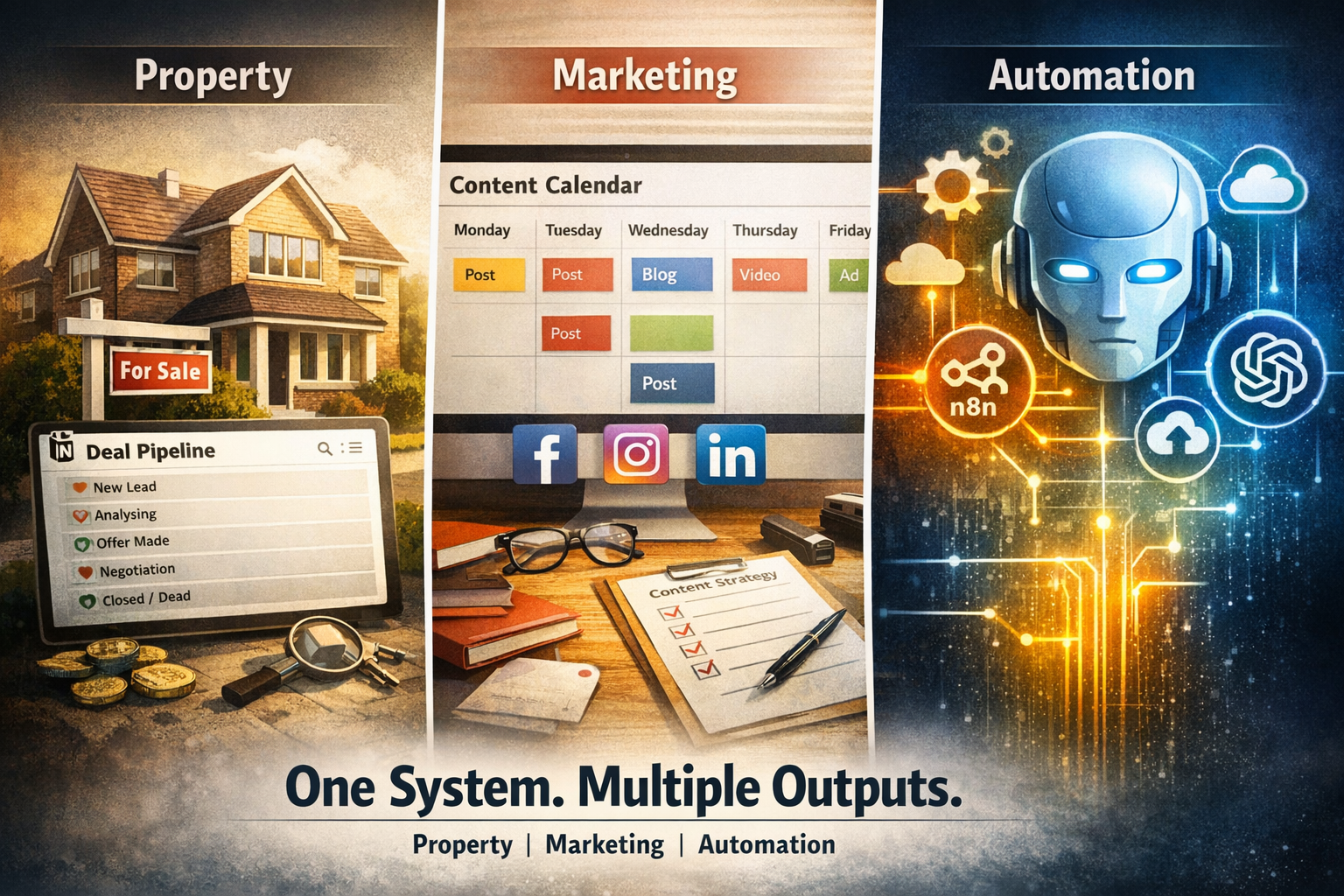
1. Deal Pipeline
You need visibility. Not memory.
A simple pipeline:
New Lead
Analysing
Offer Made
Negotiation
Closed / Dead
No complexity. No overthinking.
This alone will outperform most investors who rely on scattered messages and mental tracking.
2. CRM (Your Real Asset)
Most investors don’t have a proper CRM. That’s a mistake.
Track:
sellers
investors
agents
sourcers
contractors
Each contact should include:
interaction history
current status
next follow-up
This is where deals actually come from — not listings.
3. Deal Analysis
Instead of multiple spreadsheets:
Keep one structured view:
purchase price
refurb costs
ROI / yield
strategy (BTL, BRRR, HMO, flip)
One deal. One place. One decision.
4. Task System
Every deal is a chain of actions.
calls
viewings
quotes
legal steps
If it’s not tracked, it won’t get done.
And if it doesn’t get done — you lose the deal.
5. Knowledge Base (Keep It Tight)
Most people overbuild this.
Don’t store everything. Store:
checklists
SOPs
repeatable processes
If it doesn’t get reused, it doesn’t belong there.
Not Just Property: Where Notion Really Shines
Here’s something most investors miss.
Notion isn’t just for property — it’s a business operating layer.
Used properly, it works just as well for:
Marketing
content planning
social media pipeline
blog + SEO tracking
lead magnets and funnels
You can literally run your entire content engine from one place.
Operations
SOPs
workflows
team management
onboarding
Instead of explaining things 10 times — you build once and reuse.
Personal Systems
goals
habits
learning
project tracking
Same logic, different use.
That’s the real leverage — one system across everything.
Where Most Investors Go Wrong
There are predictable failure points:
Overbuilding the system before doing any deals
Not using it daily
Treating organisation as progress
Splitting data across tools with no structure
This is where Notion turns from an asset into friction.
Where It Gets Interesting: n8n + AI
Here’s where most people either level up — or completely overcomplicate things.
Notion on its own is a system.
But when you connect it to automation and AI, it becomes leverage.
n8n Integration (Automation Layer)
With n8n, you can turn Notion into a live system instead of a static dashboard.
Examples:
New property lead → automatically added to your Notion pipeline
Status change → triggers follow-up reminders
Form submission → creates deal + tasks instantly
Marketing content idea → pushed into your content calendar
Weekly summary → sent to your email or WhatsApp
This removes manual admin — which is where most investors waste time.
AI Layer (Decision & Content Support)
Connecting Notion with tools like OpenAI or ChatGPT adds another layer:
auto-generate deal summaries
draft follow-up messages to sellers
analyse notes from calls
turn deal data into investor updates
generate blog posts and social content from your pipeline
Now your system doesn’t just store data — it helps you act on it.
The Reality Check
This is where people get it wrong:
They build automation before they have a working process.
That’s backwards.
Rule is simple:
System first → automation second → AI last
If your manual process doesn’t work, automation will just break it faster.
Real-World Contrast
Investor A:
Notion as notes
no pipeline
inconsistent follow-up
→ “There are no good deals right now”
Investor B:
structured pipeline
tracked contacts
consistent actions
→ sees opportunities earlier, moves faster, closes more
Same market. Different outcome.
What Can Go Wrong
Overengineering dashboards instead of doing deals
Building automation without understanding your workflow
Relying on AI instead of thinking
Not reviewing your pipeline regularly
Tools amplify behaviour. They don’t fix it.
Final Takeaway
Notion is not the advantage.
Clarity and execution are.
But when used properly:
it gives you structure
it removes friction
it increases speed
And when combined with n8n and AI:
it reduces admin
improves consistency
creates real leverage
And because it works across property, marketing and operations — you’re not building separate systems. You’re building one engine.
Used correctly, it’s not just organisation.
It’s control.